The First Impact is the name given to the chain of disasters that closed the Merethic Era. It is reckoned among the worst catastrophes in the recorded history of Auridon, and it is the event that ended the Dwemer as a people and the Men of the deep cities as slaves. Most of what is known comes from the testimony the Dunmer gave the Men of the surface in the centuries after, and from the broken recollections of the Men who escaped the deep cities, and these two bodies of testimony agree on what was seen and almost never on what it meant.
What can be stated with confidence is the sequence. A relic was taken from Sotha Sil. The Dwemer vanished. A machine of their making came up out of the deep and walked north. The Tribunal raised the Hortator against it. The machine was thrown down at last upon Mount Ator, and the mountain erupted, and what the eruption did to the island it has never wholly recovered from. The causes that joined these events into a single chain are not recorded and may never have been known to any mortal who lived to write of them.
Of the Theft of the Clockwork City
The realm of Sotha Sil is not a place on Auridon. It is the Clockwork City, a metaphysical realm of his own design, contained within pocket dimension in a crystal orb no larger than the head of a small child and hidden in the deep places of Tel-Aruhn. A body must be reduced by magic before it can enter the orb at all, and the realm within is sealed against intrusion by every art its maker could devise. No assault upon it had ever been recorded before the events of the First Impact, and none has been recorded since.
The assault that did take place is known only in outline, and only because the Dunmer could not have failed to know that the realm of one of their gods had been violated. War-constructs of the Dwemer entered the orb. They fought the Clockwork Apostles, the followers of Sotha Sil who keep the realm, and they reached the inner section where the realm's relic was kept, and they took it. What the relic was, the accounts do not agree, save that the theft was an injury to Sotha Sil from which the accounts suggest he did not quickly recover.
Of the Disappearance of the Dwemer

What the Men remember of that era is that the Dwemer were building something. In the testimony, the deep folk had laboured in secret on a war machine of a kind never before made, and the building of it was a blasphemy of an order the Dunmer who faced it would not describe in detail.
What is not in doubt is the disappearance itself. At a single moment, with no warning that any record preserves, every Dwemer on Nirn ceased to exist. They did not die in any manner that left bodies. They did not flee in any direction that left tracks. The deep cities that had been the loudest and most populous places on the island fell silent between one breath and the next, and the silence was complete. No Dwemer has been seen on Nirn from that moment to this. How the building of the machine caused their vanishing, the chronicler cannot determine but in every text of the time the two events are connected. The Dunmer held that the blasphemy and the punishment were one event, and the Men had no grounds and no inclination to dispute them.
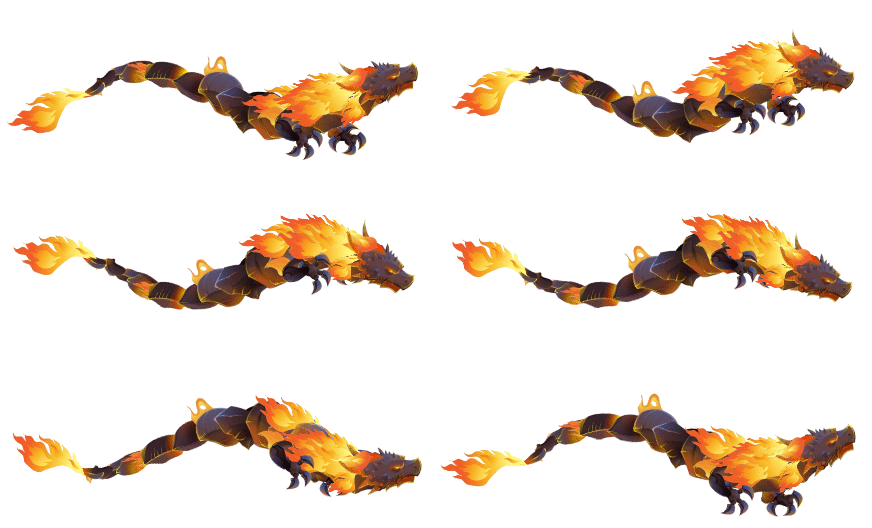
The machine remained. Whatever it was, it did not vanish with its makers. In the aftermath of the disappearance it broke out of the deep city of Darkmoor and came up onto the surface, and it turned north.
Of the Escape of Men
The deep cities of the Dwemer had been worked for nearly a thousand years by the descendants of the Men who came to Auridon with Isildur. These Men had been taken below within a generation of their landfall, and their children had been born to bondage, and no member of the captive peoples had walked under the sun since the days of the founding of Kortirion. When the Dwemer vanished, the doors of the deep cities stood unguarded for the first time in the memory of any living thing within them.
The escape was not the swift deliverance that the later songs of Men have made of it. The captives had been kept among the works of their masters without ever being taught to operate them. The great doors, the lifts, the sealed galleries and the mechanisms that governed air and water in the deep places were Dwemer contrivances, made for Dwemer hands and Dwemer understanding, and the Men who now found their keepers gone did not know how to make them move. From Darkmoor, where the machine had left only ruins of the Dwemer contraptions, Men walked out within days. From other cities the escape took months of labour against doors that would not open, and from some it never came at all.
The first to escape came up into a ruined and dangerous country and their freedom did not last long, for those who won free of the deep cities before the eruption that ended the disaster did not survive the eruption's aftermath. The Men who lived to build the cities of the Empire were, almost without exception, those still labouring underground when Mount Ator broke, and who were thereby sheltered from the worst of what the surface suffered. The deliverance of Men was not gentle and the deep that had held them captive sheltered the last of them in the end.
The Summoning of the Nerefin

The machine continued north, and its course was not in doubt. It was making for Ascalon, the realm of the Dunmer, and it suffered nothing to stand in its path. A thing of Dwemer making, marching on the people the Dwemer had warred against in the last age, gave the Dunmer every reason to read the machine's advance as a thing intended. They believed it had been built to destroy them, and that it pursued that even after its makers were gone.
The legends say that the red roses that bloomed in the Dragon Plains before the Rise of the Lich King, bloomed once again with the passing of the machine. The reason for this has been the cause of countless arguments between scholars without any theory being considered more plausible than the others.
Against it the Tribunal raised the Hortator. The working that calls the soul of Nerevar into a living vessel had been performed once before, in the War of the Black Moon, and the vessel of that first incarnation is remembered as the Nerevarine. The vessel raised against the machine was the second incarnation, and the accounts of the disaster name this incarnation the Nerefin. As before, the three Sorcerer-Kings poured a great portion of their divine power into a mortal of Dunmer birth, and the Nerefin woke with the memories of the old war-chief and the strength of the three behind them.
The contest between the Nerefin and the machine lasted weeks. It was fought without pause, by day and by night, across the Dragon Plains, and nothing the Nerefin did in the early phase of it could halt the machine's advance. It crossed the Girdle of Vivec, the barrier of light that had turned back the dead in an earlier age, and the Girdle did not stop it. It continued into the heart of Ascalon, and the destruction of its passage was beyond reckoning.
Of the Eruption of Mount Ator

That ground of the final battle was Mount Ator, the great volcano upon whose slopes the Elven Wars had ended an age before. The machine came to the mountain and ascended it, and upon its summit the Nerefin at last brought the long contest to its end. The machine was overthrown, and it fell from the height into the crater, as the avatars of the First Tribunal had fallen into the same crater at the close of the previous age.
This time the mountain answered. Mount Ator erupted, and the eruption was unlike any natural disaster the island had known, for the thing that had fallen into the crater was not natural, and what the fire drew out of it was not natural either. A shockwave of raw magic went out across the whole of Auridon from the summit. Where it passed over the Dunmer realm it shattered cities that had stood since the founding of Ascalon, and the loss of life among the Dunmer in that single passage brought the people to the edge of extinction. The realm did not recover its old extent and did not again hold the country it had held before the wave.
The wave wrought stranger changes than the breaking of cities. When the Men who fled the deep cities after the eruption reached the surface, they found Argonians in the wilderness of the country, a beast-folk originally from the Black Marsh of Tamriel. The Men did not know where the Argonians had come from, and the two peoples met as rivals for the same ground and contested it for generations.
Of the Oblivion Crisis

The eruption of Mount Ator did not end the chain of disasters, the magic released in the event had thinned the wall between Nirn and Oblivion and in the months and years after the eruption, gates to Oblivion opened across Auridon, and through them came the Daedra.
The period that followed is remembered as the Oblivion Crisis. For many years the gates stood open across the ruined island, and the daedra that issued from them ranged over a country already broken by the eruption and emptied by the disappearance of the Dwemer. The defence of what remained fell to the Nerefin, who did not lay down the burden of the Hortator with the destruction of the machine but turned from it to the longer war against the gates. The accounts of this war are fragmentary, for the chroniclers of the surviving peoples had little leisure to write in those years. What they record is that the Nerefin fought the Daedra of the open gates for a great span of years, and that the gates were closed in the end, though the accounts do not agree on how, or at what cost.