
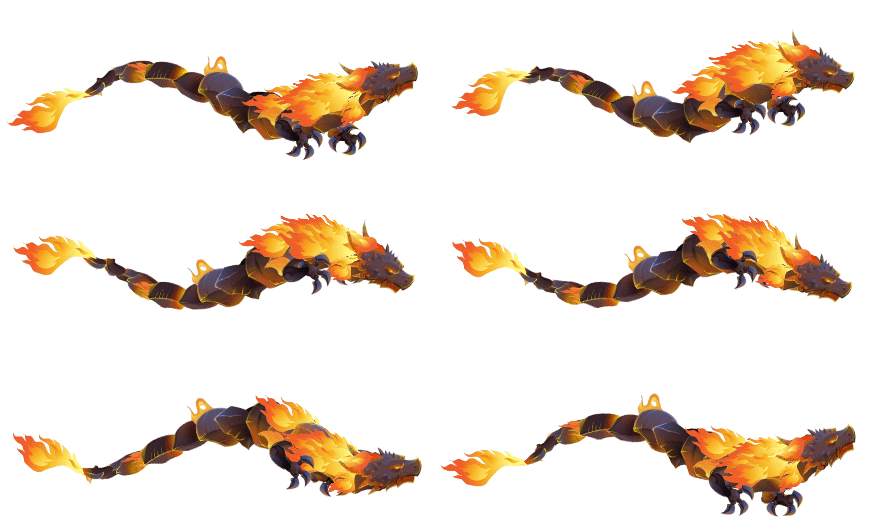
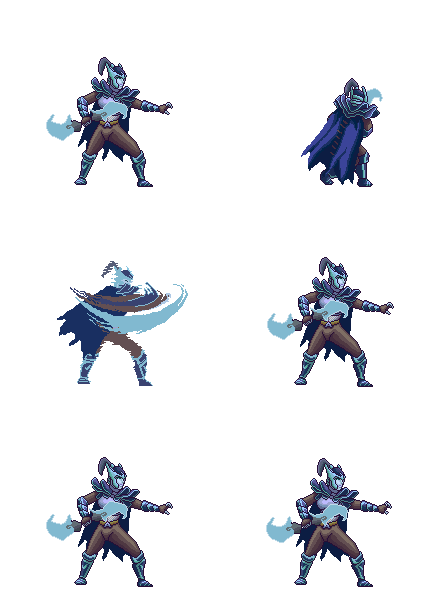
The Lich-King was the first known mortal in Auridon to strip a soul from the Aetherius and bind it to a body of dead flesh in Mundus. The chronicles preserve no certain account of his origin. He held no priestly office and was not numbered among the recognised mage-orders of his day; the records know him only by the title he later took, and by what he did. Since his first acts took place in the Dragon Plains forests, some scholars speculate that he might be a Bsomer, with no proof to support the theory.
What is recorded with certainty is that his art was new. No prior Merethic thaumaturgy had broken the cycle by which the souls of the dead return to Aetherius, and no mer of Auridon had raised the dead to walk under their own intelligence.
The Plague

The first sign of the Lich-King was his pestilence dated circa 306600. It rose in the deep forests of the Dragon Plains and spread outward toward the settled country.Animals were the first carriers. Wolves, boars, the great forest deer and the fastest to spread of all, the rats, fell to the sickness, becoming rabid, and what fell did not stay fallen. The corpses rose within hours, mindless and aggressive, and what they bit took the disease in turn. The plague soon crossed species and infected mer. From there it moved quickly. The cities of the Dragon Plains were lost one by one; the chronicles list their names but record little of their endings. Refugees carrying the disease reached the borders of Ulumbra and Ascalon before the cordon could be drawn.
Almalexia withdrew her people from the eastern settlements and gathered them at Tel Aruhn, which held. The Altmeri response was slower and less unified.
The Girdle of Vivec
Vivec raised the working that bears his name in the third year of the plague. It was a barrier of light, drawn between Lake Lenorv in the west and Lake Amon in the east, and it sealed the territory of Ascalon from the contaminated west. The Girdle did not kill the evil creatures that crossed it. It unmade their purpose. Creatures of the Lich-King's making, on passing the line, lost the animating direction of their master and wandered without aim, neither attacking nor defending, until the bodies failed. They did not respond to strikes, nor to fire, nor to the voices of the living. They walked until they fell.
The Girdle held. Ascalon was preserved, and the line between it and the lost country remained drawn for the rest of the reign of the Lich-King. The working has diminished with the centuries and is no longer what it was, but some portion of its virtue remains in the land between the two lakes.
The Doom of Ulumbra
The Altmer that had remained in Auridon after the Altmer Exodus of circa 3E3500 had no possibility of resisting the necromantic plague. The realm succumbed to the dark forces of the Lich-King and Altmeri culture finally disappeared from Auridon with it.
The Reign in Darkness
The Lich-King answered the Girdle with a working of his own. Over the territory he had taken he drew a perpetual darkness, unbroken by sun or moon, and held it there by his own power. The chronicles describe a sky of unrelieved black above the fallen cities, and a cold light, where light reached at all, that did not come from any source the living could name. It was a deliberate inversion. Where the Girdle gave a steady and calming light to the country it protected, the Lich-King's dominion gave only the absence of light, and the absence was held in place by his will.
How he came by the power to sustain such a working is not known. The folk traditions of later ages assign the origin of his art to one or another of the Daedric Princes. Some say Molag Bal, who is named in many places as the patron of undeath. Some say Clavicus Vile, on the reasoning that no mortal acquires such mastery without a bargain. Some say Namira, whose dominion includes the things that crawl in darkness and that should not be looked upon. The chronicler cannot adjudicate between these accounts. The Lich-King left no testament of his patrons, and the priests who might have known died early.