
The Green Pact and the Divergence of the Bosmer
Another of the clans to stem from the Aldmer in the opening centuries of the Daedric Era were the Bosmer.
To understand what was done to them, one must recall a figure from the Dawn. Y'ffre, one of the lesser et'Ada who gave himself to Mundus as an Earthbone. His sacrifice was the law by which all things hold their form: it is on account of Y'ffre that a tree remains a tree from one hour to the next, and a mer a mer. Before Y'ffre, the shapes of living things had shifted constantly, flowing into one another with no stable truth to any of them. Y'ffre's gift was the first naming, and it is for this that he is sometimes called the Storyteller. His passing into law was one of the greatest acts of the Dawn.
One Prince watched that passing very closely. Hircine, the Prince of the Hunt, had an interest in Y'ffre's work that the other Princes did not share. He understood, as Y'ffre dissolved into the architecture of Mundus, the precise mechanism by which form was fixed. And by watching that he understood the mechanism by which that fixing could be undone.
It was with this knowledge in his keeping that Hircine came, in the opening centuries of the Daedric Era, to look among the mortal races for a people who might serve as his hunters and as the wardens of the forests of Valenwood, which he considered his own. He found them among the Aldmer who had wandered east into the great forests beyond the old homelands. These were scattered clans, far from the old courts, and they were by disposition already more comfortable among beasts and trees than among the towers and libraries their cousins preferred. To them Hircine proposed a bargain called the Green Pact.
The Bosmer would guard the forests he named sacred, they could not harm the forest in any way, and they could not use plant matter for any purpose a beast's matter could serve instead. They could not sow and could not reap. Their weapons would be of bone and horn and sinew; their clothes of leather and shell; their drinking vessels of chitin and skull. Their dwellings would be grown rather than built: the trees themselves coaxed into shelter by a shaping-song. A Bosmer village is therefore a living place, no less a part of the Forest than the deer or the hunter.
They consume only meat, and all the meat of whatever beast they slay without leaving anything to waste, to rot. They would also eat their own when one of them fell in battle as an honorful rite, not a desecration. The outsiders have told themselves many stories about the savagery of the Wood Elves, and it is worth saying plainly that the stories are in most respects accurate, though the Bosmer would not call the behaviour savage. They would call it the proper conduct of a people whose bargain is with the hunt.
What Hircine gave them in return for this discipline, beyond the protection of the Forest, was to be able to do what Y'ffre's law had made impossible for all other mortal kinds. A Bosmer can become a wolf, a bear, a stag, a hawk, or any sort of monster. Stronger shifts are possible in proportion to the Bosmer's skill and the Prince's favour. This pact is how lycanthropy came to be on Nirn, but this disease is not by any means the most extreme transformation the Bosmer can take.
The Wild Hunt
The deepest working built into the Green Pact is the ritual called the Wild Hunt, and it is invoked only in the gravest of circumstances. Most Bosmer will live and die without seeing one, and the great majority of those who do see one do not survive it.
The Wild Hunt is a collective ritual. A sufficient number of Bosmer, gathered and bound by the rite, give up their fixed form all at once and at the same place, undoing Hircine's gift in the opposite direction from its usual use. They do not become wolves or bears. They become something that has no single shape at all: a horde of shifting, unfinished beasts, half one thing and half another, tentacled, taloned, feathered, scaled, flickering from form to form faster than the eye can follow them. This is what the Bosmer call the Ooze, and it is understood as a deliberate return to the pre-Earthbone state of things, before Y'ffre's naming had given anything a shape it could keep.
"A flood of horrific beasts, tentacled toads, insects of armor and spine, gelatinous serpents, vaporous beings with the face of gods, all poured forth from the great hollow tree, blind with fury."
— A Dance in Fire, Chapter 4, by Waughin Jarth
The horde so produced tears through whatever lies in its path. It does not distinguish between the enemy that provoked it and anything else in reach, which is why the Hunt is invoked only against threats so total that the Bosmer judge the cost of collateral destruction to be lesser than the cost of survival on the enemy's terms. When the horde has exhausted its outside targets, it turns on itself, for the beasts of the Hunt cannot stop hunting, and the last phase of every Wild Hunt is therefore a cannibalistic orgy in which the participants devour one another. The transformation is irreversible. A Bosmer who takes part in the Wild Hunt does not come back.
Historical invocations of the Hunt are few, and every one of them is remembered and entered into legend. It is said that every monster witnessed by men has come from a Wild Hunt. The Bosmer themselves do not boast of the ritual, and to most outsiders who have heard of it at all, the Hunt is spoken of in the same register as plague or earthquake: a calamity to be averted rather than a weapon to be sought. The Green Pact permits the Hunt, but Hircine's favour does not oblige any Bosmer to call upon it, and the leaders of the Forest have traditionally opposed its use in all but the most dire circumstances.
King Dead Wolf-Deer

Not all who enter the Hunt are devoured at its close. On rare occasions a participant survives the cannibalistic phase, either by outlasting every other beast in the horde or by having been already too much changed for the ordinary laws of its ending to apply. Such a survivor does not return to mer-form. He remains a creature of the Ooze, locked into whatever mixture of shapes the Hunt had imposed on him in its last moments, and he wanders the world alone, unmaking whatever he comes near.
The most famous of these survivors is the being called King Dead Wolf-Deer, whose name describes his form well enough. He was, according to the Bosmer traditions that remember him, an actual king of his people during the Daedric Era, who led the first Hunt himself and was alone in walking out of it. He has been hunting ever since. His usual haunts are the uplands of High Rock.
The last recorded mortal encounter with Dead Wolf-Deer comes from the years after the First Impact. In the trial convened against the Sorcerer-King Vivec to judge his conduct during the disaster, which lead to the Night of Cinders, the official accounts state that the proceedings required the summoning of Azura as a witness, and that the ritual of summoning required as its catalyst one of the antlers of Dead Wolf-Deer. These accounts seem to intend that Vivec conisdered the beast to be still alive, despite twenty thousand years had passed from the time of the first Hunt. This would make Dead Wolf-Deer one of the most ancient mortals on Nirn, if he can even be considered a mortal at all.
The Khajiit and the First Civilisations in Cyrodiil
Some of the Bosmer used HIrcine's gift to pass out of the mer-form altogether. Between these are the Khajiit, the beastfolk who now inhabit the deserts of Elsweyr and who are sometime found, in smaller numbers, throughout the known world.
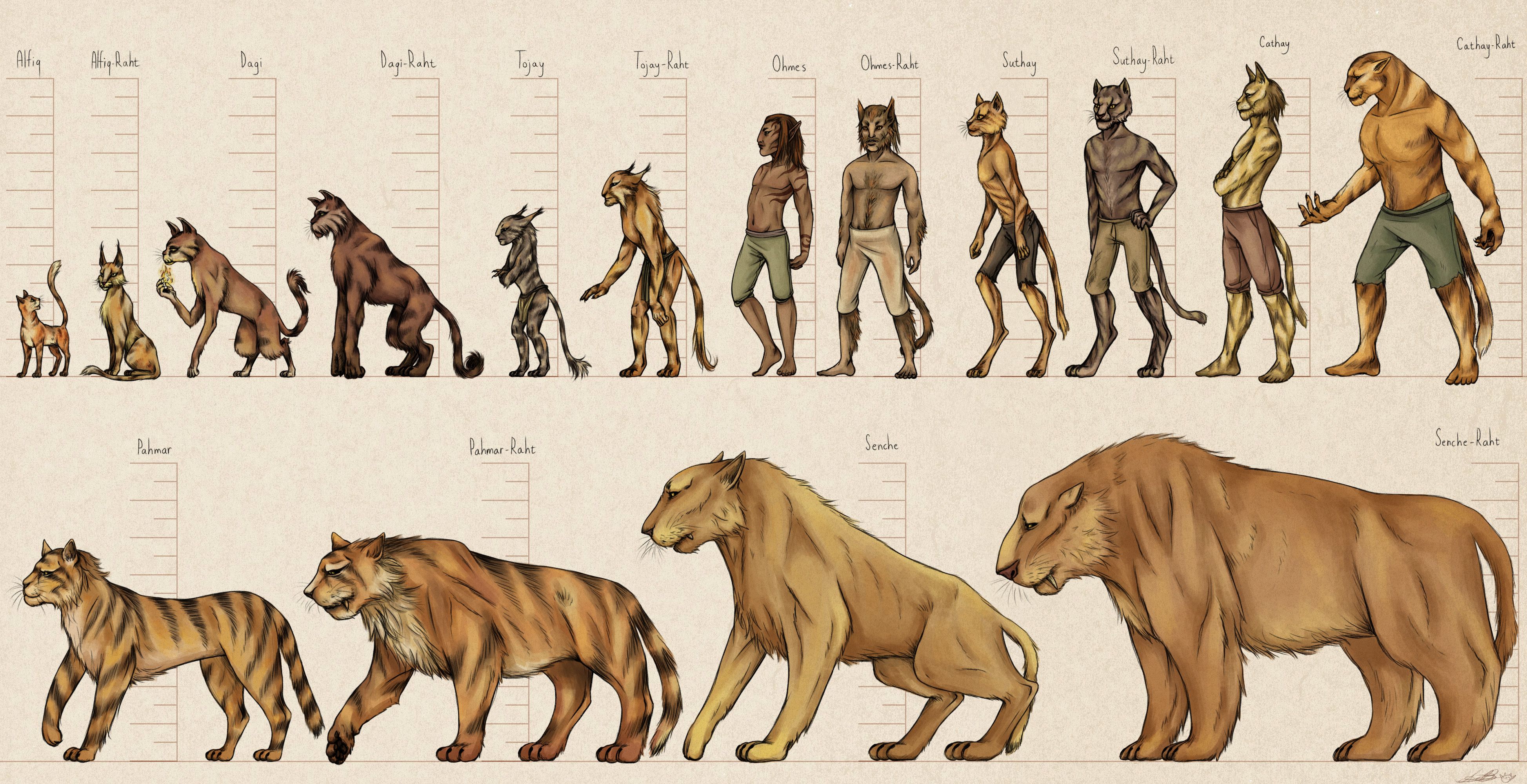
The Khajiit are not a single shape, and the particular form any given Khajiit takes is fixed at birth by the phases of the moons, Massa and Seconda. Seventeen distinct forms, called furstocks, are produced by the seventeen significant combinations of the two phases, and any two Khajiit siblings born under different skies will differ from one another as profoundly as a housecat differs from a warhorse.
At the smaller end of the range sits the Alfiq, who resembles a common housecat in size and shape and is often mistaken for one. The Alfiq is in fact a fully sapient Khajiit, capable of speech and particularly gifted in magic, though the gift is easier to exercise than the speech, for the Alfiq's jaw was not made for Tamrielic vowels. The Ohmes and Ohmes-raht, at the other end of the spectrum, are nearly indistinguishable from Bosmer or men, differing chiefly in a light covering of fur and a tail, and they are therefore the furstocks most often encountered by outsiders who have no idea they are dealing with Khajiit at all. Between these extremes lie the more conventionally feline forms: the Suthay and Cathay, bipedal and roughly mer-sized, the shape most travellers picture when they hear the word Khajiit; the Dagi, small and agile, tree-dwellers by preference; the Pahmar, large and muscular, tiger-faced, deployed as guards and warriors; and the Senche and Senche-raht, the great quadrupedal battlecats, some of them as tall at the shoulder as a horse and weighing as much as twenty grown men. A Senche-raht is ridden by its smaller kin into battle as often as it acts alone.
The earliest Khajiit emerged in the forests south and east of the old Bosmer homelands. They did not remain there, the Khajiit moved east, and they crossed in great numbers into the jungles of what was then called the Heartland, the central basin of Tamriel that later ages would call Cyrodiil.
The Bird-folk of the Heartland
The Heartland was not empty when the Khajiit arrived. It was held by a people called simply the Bird-folk, tall humanoid creatures covered in brilliant plumage, with taloned feet and the wings of great raptors. The Bird-folk are considered to be among the most direct descendants of the Wandering Ehlnofey. By the time the Khajiit entered their territory, the Bird-folk had already built a scattered but enduring civilisation along the rivers of the Heartland, centred on a cluster of eight islands at the confluence of the Niben and its tributaries. They are the oldest known inhabitants of Cyrodiil.
They were not equipped for what came next. The Khajiit, being beastfolk and hunters by Hircine's bargain, regarded the Bird-folk as game. What followed was not a war in the ordinary sense. It was a long predation, carried out over many generations, in which the Khajiit hunted the Bird-folk, and the Bird-folk, whose civilisation had never developed against any predator of comparable scale, could not mount a defence that held. Their numbers collapsed. Whole flocks were taken in a single season. By the close of this first contest for the Heartland the Bird-folk had been reduced to scattered remnants, hiding in the deeper forests and on the eight islands at the centre of the basin, where the waters offered some small protection that the open ground had not.
The Ayleid Settlement and the White-Gold Tower

The Khajiit did not remain in the Heartland. Over the generations that followed their great predation, their numbers and the attention of their furstocks turned south-east, toward the drier lands beyond the jungles, and by slow degrees they migrated out of Cyrodiil and into the region that is today called Elsweyr. By the time the next settlers arrived in the Heartland, the Khajiit presence had thinned almost to nothing.
The next settlers were mer. They were a faction of Aldmer who had set out across the sea from the old homelands, seeking fertile land that the other splinters had not already claimed, and they made landfall on the western coast of Cyrodiil and pressed inland along the rivers. They found the Heartland depopulated of the Khajiit and reduced to isolated pockets of surviving Bird-folk, and they set about making the region their own. These settlers are the Ayleids, sometimes called in their own language the Saliache, the Hidden Ones. They are accounted in this chronicle as a subspecies of the Altmer, for they remained racially Aldmer in every respect that matters, their distinctiveness is cultural rather than biological.
The Bird-folk who remained were finished off over the first centuries of Ayleid settlement. The Ayleids were more systematic than the Khajiit had been. Where the Khajiit had hunted for food and for the pleasure of the hunt, the Ayleids cleared the Bird-folk from their chosen land the way a farmer clears a field, and they did it with the patience and the taste for display that would mark Ayleid civilisation in every subsequent age. The feathers of the fallen were not wasted. The Ayleids took them as ornament, and feather-work became one of the signature adornments of their high culture, worn on cloaks, staves, headdresses, and ceremonial armour throughout the Daedric and Merethic Eras. An Ayleid of rank was rarely seen without a plume of some colour, and the brighter and rarer the feather, the greater the honour. By the time the last of the Bird-folk had passed out of living memory, their plumage lived on in the regalia of the people who had ended them.
On the central island of the eight, at the confluence where the Bird-folk had made their last stand, the Ayleids raised the White-Gold Tower. It is the third of the Towers of Nirn after Ada-Mantia and the Red Tower, and the first of them to be raised by the hand of a living mortal people rather than by the Aedra of the closing Dawn. Its Stone is of Aldmeri working. The Tower fixed the Ayleid claim on the Heartland in the same way Ada-Mantia had fixed the Direnni's claim on the old west, and from its base the Ayleids would rise over the following ages to become, for a time, the dominant power of the continent.