
A Note on the Name
The alliance treated in this entry is best known as the Triumvirate, after the three sorcerer-kings who founded it. In the centuries immediately following its emergence it was more often called the New Tribunal, in deliberate contrast to the First Tribunal of Azura, Hircine, and Mehrunes Dagon, whose example the three were both following and rejecting. After the First Tribunal dissolved, the qualifier fell out of use, and what had been the New Tribunal became simply the Tribunal. All three names refer to the same three figures, and the choice between them is largely a matter of which era a given author is writing from.
This chronicle uses Triumvirate throughout, both for clarity and because the term is the one the three sorcerer-kings used of themselves at the founding.
The Chimer Distrust of the Princes
The teaching of soul-craft that Azura had passed to her Altmer was not received uniformly. To most of the Altmer, the gift was what it appeared to be: a refinement of magical practice, a kindness from the Prince who had taken them as her people. To a smaller faction, the same gift looked like something else. If a Prince could teach mortals to bind life essence to vessel and draw power upon it at will, then a Prince could also teach mortals to do considerably worse, and the difference between the two teachings was a matter of the Prince's discretion alone. The faction reasoned that any people whose civilisation rested on a Prince's discretion was not, in any meaningful sense, a free people.
The articulation of this view fell to a prophet called Veloth. Veloth was highborn, educated in the old Altmer schools, and had himself studied the soul-craft before he turned against it. His sermons held that the entire arrangement of the First Tribunal was a slow and elegant betrayal: the mer peoples had been parcelled out among three Princes for the Princes' convenience, the gifts each people had received were the gifts that bound them tightest, and the dignity of the mer as the inheritors of the Dawn had been traded for a comfort that was not theirs to keep. He preached that a true mer ought to take the Princes for what they were, powerful, useful, and not to be trusted, and ought to look elsewhere for the foundation of a civilisation that could stand on its own. He did not say where that elsewhere lay. He said only that finding it was the work the Altmer had been avoiding for the entire Daedric Era.
His followers were a minority, but a determined one. They took the name Chimer, the Changed, to mark themselves off from the Altmer who had not changed their minds. The name was a polemic before it was an ethnonym, and it was meant as one.
Veloth lead the Chimer in a mass pilgrimage out of Summerset, to North-East, across Tamriel and eventually reached a wild region of land he named after himself but in later eras became known as Morrowind. There the Chimer settled and laid the foundations of their own civilization. After the natural death of Veloth three figures took Veloth's argument further than he himself had been willing to take it.
The first was Sotha Sil, an engineer of considerable ambition who had risen to prominence as the mentor of the Chimer's military commanders and whose private ambition, not widely known at the time, was to construct a pocket realm of his own within Oblivion, a place answerable to no Prince and ordered entirely to his design. The second was Almalexia, a healer whose temples drew followers from every quarter of Altmer society and whose authority was the authority of a person whom thousands of mer already loved. She was the wife of one Nerevar, a war-chief and disciple of Sotha Sil of growing reputation among the Chimer hosts, and her social standing drew on his military reputation as well as on her own following. The third was Vivec, a mercenary of obscure birth who had taken service in the Chimer armies and become, in the course of that service, one of Sotha Sil's most gifted students. Where Sotha Sil's authority was technical and Almalexia's was social, Vivec's was earned in the field.

The Apotheosis and the Sack of Coldharbour
The three concluded, by reasoning that the sources do not preserve in full, that the only power on Nirn sufficient to free the Chimer from the Princes was the power that had made the Princes possible in the first place and that was conveniently located in Morrowind. They went looking for the Heart of Lorkhan.
The Heart, since its tearing from Lorkhan's body at Convention, had lain at the foot of the Red Tower, serving as that Tower's First Stone. What they did when they reached the Tower is the gravest charge that has ever been laid against them, and it is laid against them justly, at least in the eyes of the other mer. They tampered with the First Stone, drawing power from it by means the chronicler will not attempt to describe, because no honest source describes them.
They came down from the Tower as gods and took on the title of Sorcerer-Kings.
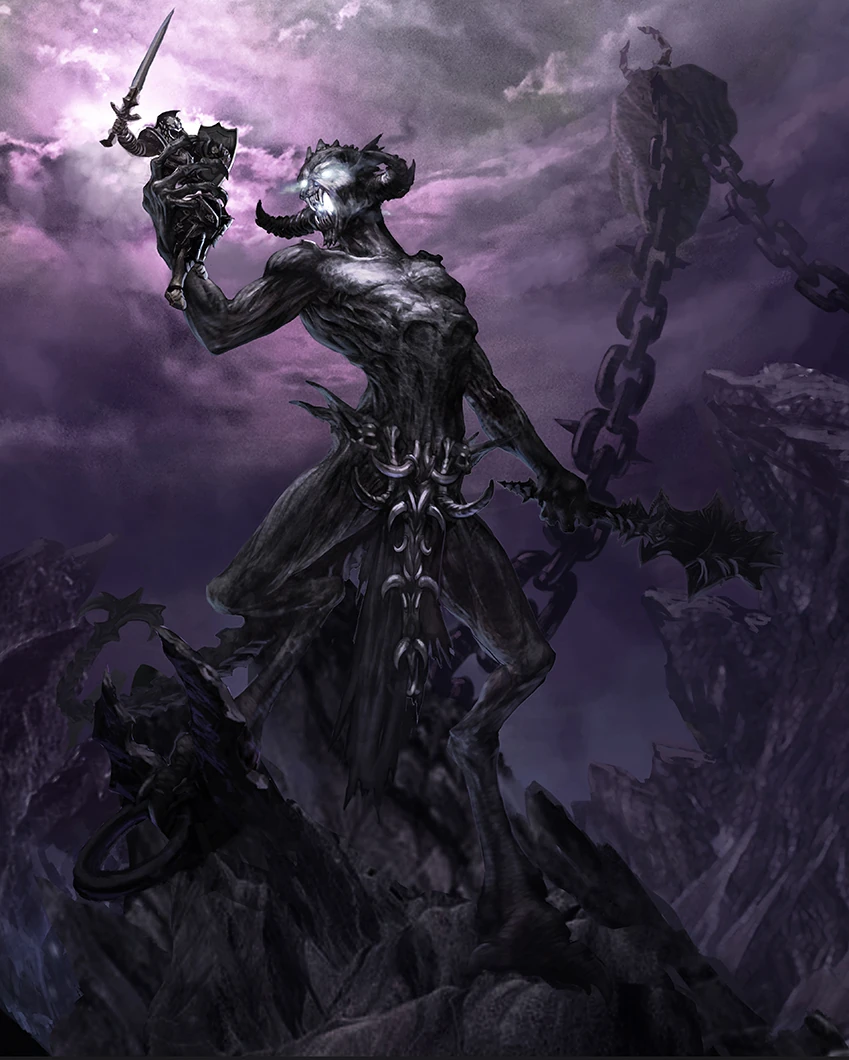
The three did not return to Summerset directly. They went first to Coldharbour, the realm of Molag Bal, and they did so for the same reason a young soldier picks the largest opponent in the yard: to settle the question of their stature in the only way that would settle it. The assault on Coldharbour is the act by which the Triumvirate announced itself. The sources are unanimous on the broad outline. The three entered the realm uninvited, fought their way to its centre, and confronted Molag Bal in his own hall.
What followed is preserved most fully in the 36 Lessons, which the reader is referred to. The chronicler will note only that Vivec, in the course of the engagement, took from Molag Bal a portion of the Prince's genitalia, fashioned it into a spear, and named the spear Muatra.
In the deeper reaches of Coldharbour, in the course of the same assault, the three came upon the souls of the Bosmer of Gil-Var-Delle, still held by Molag Bal in the condition to which he had taken them. They freed them. The released souls departed Coldharbour by paths of their own, and their fate after that is not known. Whether the three had intended this rescue when they entered the realm, or whether they came upon the captives by chance and acted as they happened to find them, is a question the sources do not settle. Hircine, when word of the rescue reached the First Tribunal, is said to have received it without comment, which the chronicler reads as the most damning available verdict on the matter. The new gods had done in a single working what the older alliance had failed to do in nearly twenty thousand years.
The Triumvirate returned to Summerset as kings. The Chimer who had remained there welcomed them. The Altmer who had not followed them were a great deal less pleased. The three established themselves in the north of Summerset and declared their people independent of the Altmer in matter of governance and of patronage alike. The First Tribunal had nothing to say in response that they were prepared to say in public. The Chimer, for their part, had become what Veloth had predicted but had not lived to see: a people whose civilisation rested on no Prince's discretion.